
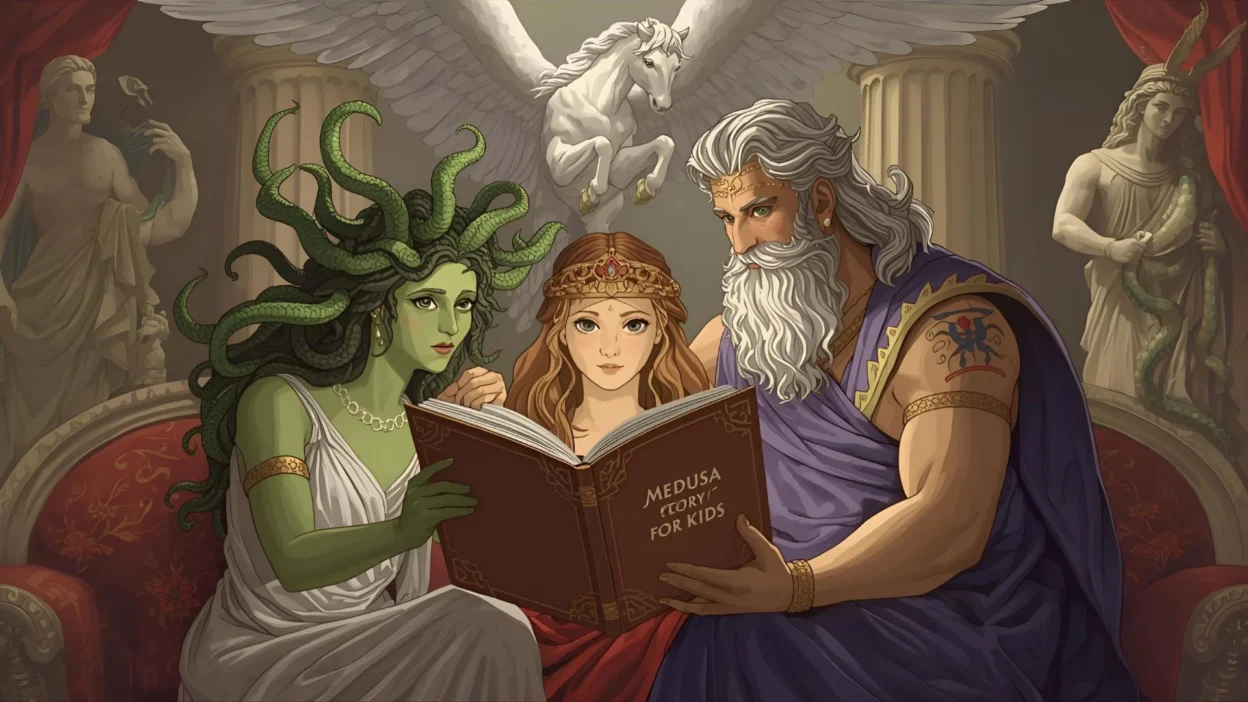
Greek mythology continues to be a hot and trending topic in 2025, especially for adults searching for the best Medusa story for kids. These timeless tales provide adventure, moral lessons, and a glimpse into ancient legends. Whether you’re exploring a Medusa short story, the story of Medusa and Athena, or wondering is Medusa real, these narratives are not just entertaining but deeply meaningful.
This collection includes simplified yet engaging versions perfect for an adult audience to share with younger listeners. You’ll also find connections to Perseus and Medusa story for kids, and even a Medusa story summary that highlights key events. Get ready for the top adaptations that make mythology easy, fun, and unforgettable.
Story 1: The Girl with the Golden Hair
Long ago, in ancient Greece, there lived a girl named Medusa who was known for her golden hair and kindness. She worked in Athena’s temple, lighting lamps and keeping the place clean. People admired her beauty and spoke of her gentleness. But with admiration came jealousy.
One day, Medusa’s pride grew. She stood before the temple mirror and whispered, “I am more beautiful than Athena herself.” Unfortunately, those words echoed into the heavens. The goddess Athena, known for wisdom but also justice, appeared before Medusa. “Your heart has grown arrogant,” she declared. With a wave of her hand, Medusa’s golden hair turned into snakes, and her gaze became deadly to anyone who looked into her eyes.
Terrified, Medusa fled into the wild mountains. Though cursed, she remained lonely, wishing someone could see her heart instead of her monstrous face. Years later, a hero named Perseus came, carrying Athena’s shield. Using its reflection, he avoided her gaze and, with a single strike, ended her sorrow.
People remembered her not just as a monster, but as a reminder of how pride can blind even the kindest soul.
Moral: Arrogance destroys beauty, but humility keeps the heart pure.
Story 2: Medusa and the Garden of Stone
Medusa once lived in a quiet valley where flowers bloomed endlessly. After Athena’s curse, the valley turned into a garden of stone. Every animal that came near her gaze froze into lifeless statues. Medusa wept daily, wishing for the days when butterflies danced and deer roamed freely.
One evening, a lost traveler wandered into her valley. She warned him: “Do not look at me, or you’ll turn to stone.” The man closed his eyes, guided by her voice. They spoke for hours, and for the first time in years, Medusa felt heard. The traveler said, “Your curse is heavy, but your kindness still shines.”
Although he left safely, her valley remained filled with statues. Medusa learned that even when cursed, compassion could still be shared.
Moral: True kindness shines even through misfortune.
Story 3: Perseus and the Shining Shield
Perseus, a brave young hero, was chosen to defeat Medusa. Guided by Athena, he received a polished shield that reflected like a mirror. With Hermes’ winged sandals, he flew swiftly over mountains and rivers until he reached Medusa’s cave.
Inside, shadows loomed. Medusa slept among her two monstrous sisters. Her snake hair writhed restlessly even in slumber. Perseus knew he could not face her directly. Holding his shield in front of him, he crept closer, his eyes fixed only on the reflection.
With one strike, Perseus cut off Medusa’s head. From her blood sprang Pegasus, the winged horse, a symbol of hope rising from tragedy. Perseus carried her head back, not as a trophy, but as proof that courage and wisdom together could conquer fear.
Moral: Bravery is strongest when guided by wisdom.
Story 4: The Lonely Island of Medusa
Far away from villages, Medusa lived alone on a rocky island surrounded by crashing waves. The curse Athena gave her kept her isolated, for no one dared to approach. Yet, despite her monstrous form, Medusa’s heart yearned for friendship.
Every night, she listened to the sound of the sea and spoke to the stars. She shared her fears, regrets, and memories of her life before the curse. The stars, though silent, seemed to twinkle brighter with each word she spoke, as if listening.
One evening, a fisherman’s boat drifted near her island during a storm. Medusa saved him by guiding the boat away from sharp rocks. The fisherman never saw her face, only heard her gentle voice echoing through the waves. Though he never knew who rescued him, Medusa found comfort knowing she had saved a life.
Even in solitude, her kindness still touched the world.
Moral: Even in loneliness, acts of goodness can reach others.
Story 5: The Story of Medusa and Athena
Medusa was once a priestess in Athena’s temple, known for her devotion. She vowed never to fall in love, dedicating herself to the goddess of wisdom. But Medusa’s beauty attracted many admirers. Some whispered that she was more radiant than Athena herself.
When Medusa’s pride grew, she forgot her oath of humility. Athena, who valued discipline and respect, appeared before her. “You broke your vow and placed vanity above devotion,” Athena said sternly. She transformed Medusa’s hair into snakes, her eyes into weapons of stone.
Though cursed, Athena’s punishment carried a lesson. Medusa became both feared and remembered, not just for her tragic fate but as a symbol of what happens when pride overshadows wisdom.
Generations retold the story of Medusa and Athena as a warning: respect the gods, respect promises, and respect humility.
Moral: Pride and broken vows bring consequences, but humility preserves honor.
Story 6: Is Medusa Real?
Long ago, villagers whispered, “Is Medusa real?” Parents told their children stories of a woman with snake hair, whose eyes could turn the strongest warrior into stone. Some believed she lived in caves, while others thought she was only a myth.
One curious scholar traveled across Greece, searching for answers. He found statues scattered in a hidden valley, lifelike and frozen mid-movement. He wondered if they were once people or simply carved by talented hands.
At night, he dreamed of Medusa. She spoke: “I am not merely real or unreal. I am a story—a lesson carried through time.”
The scholar returned home, realizing that Medusa was both a myth and a truth. She was real in the hearts of those who believed and in the lessons her tale carried.
Moral: Legends may not be real in form, but they are real in the lessons they teach.
Story 7: Perseus Meets the Gray Sisters
Before Perseus could face Medusa, he needed special tools. Athena advised him to visit the Gray Sisters, three mysterious women who shared a single eye between them.
The sisters lived in a dark cave, passing the eye back and forth. They knew the secret location of the Gorgon sisters. Perseus, clever and brave, snatched the eye from them mid-passing. “Tell me where Medusa lives,” he demanded, “and I’ll give this back.”
The sisters shrieked but had no choice. They revealed the path to Medusa’s lair, hidden at the edge of the world. Perseus returned their eye and continued his quest, guided by both courage and cunning.
Without this encounter, the Perseus and Medusa story for kids would never be complete.
Moral: Cleverness, when paired with courage, can open doors that strength alone cannot.
Story 8: The Birth of Pegasus
When Perseus struck down Medusa, something magical happened. From her spilled blood, a magnificent white horse with wings—Pegasus—sprang forth. The creature soared into the sky, free and unchained.
Though Medusa’s life ended tragically, her story gave birth to a symbol of hope. Pegasus became a companion to heroes, carrying them across skies, oceans, and battles. Children who heard this tale were reminded that even in sorrow, beauty and wonder can emerge.
The villagers told and retold the Medusa story summary, always including Pegasus, who represented the silver lining behind every dark cloud.
Even today, the image of Pegasus reminds dreamers that light can shine brightest in the darkest moments.
Moral: Out of tragedy can come new beginnings and hope.
Story 9: The Shield of Reflection
Athena’s gift to Perseus was no ordinary shield—it was polished so bright it reflected like a mirror. Perseus realized he could never face Medusa directly, but through reflection, her deadly gaze could be avoided.
Step by step, shield raised, he entered the cavern. He saw Medusa only through the mirror’s shine. With precision, he struck.
This tale has been told for generations as part of the Medusa story for kids in English. It’s more than myth; it’s a timeless reminder. Sometimes, problems cannot be faced head-on. Reflection, planning, and patience are stronger than reckless force.
Moral: Not every battle is won with strength—sometimes reflection and strategy lead to victory.
Story 10: The Legacy of Medusa
Centuries passed, but Medusa’s tale never faded. Scholars asked, who killed Medusa? Others wondered, is Medusa real? Yet beyond the myths, her story carried lessons for children and adults alike.
Medusa was once kind, then cursed, then feared. But she was also remembered as a symbol of transformation. From her tragedy came Pegasus, from her end came legends, and from her story came wisdom.
Whether read as a Medusa short story or a Perseus and Medusa story for kids with pictures, the lessons remain the same: pride can bring downfall, bravery matters, and even in loss, hope survives.
Her story has become eternal—told across books, classrooms, and firesides, proving that myths live forever in hearts and minds.
Moral: Stories live on because their lessons are timeless.
Conclusion
The Medusa story for kids remains one of the best and most retold myths in 2025. From the story of Medusa and Athena to the Perseus and Medusa story for kids in English, each tale carries valuable lessons. Whether you’re reading a Medusa story summary, asking is Medusa real, or exploring a Medusa short story with pictures, these myths stay alive because they connect adults and children through wisdom and wonder.