The story of Moses for kids has remained one of the top, hot, and trending biblical tales in 2025 for families, teachers, and Sunday school learners. Whether you want a life of Moses for kids lesson, a story of Moses for kids summary, or creative story of Moses for kids activities, these timeless stories inspire courage, faith, and obedience.
In this collection, you’ll find the full story of Moses retold in simple, engaging language—perfect for adults guiding children, or anyone seeking the story of Moses in the Bible summary in an easy-to-read style. These are not just stories; they are life lessons wrapped in faith.
Story 1: Baby Moses in the Basket
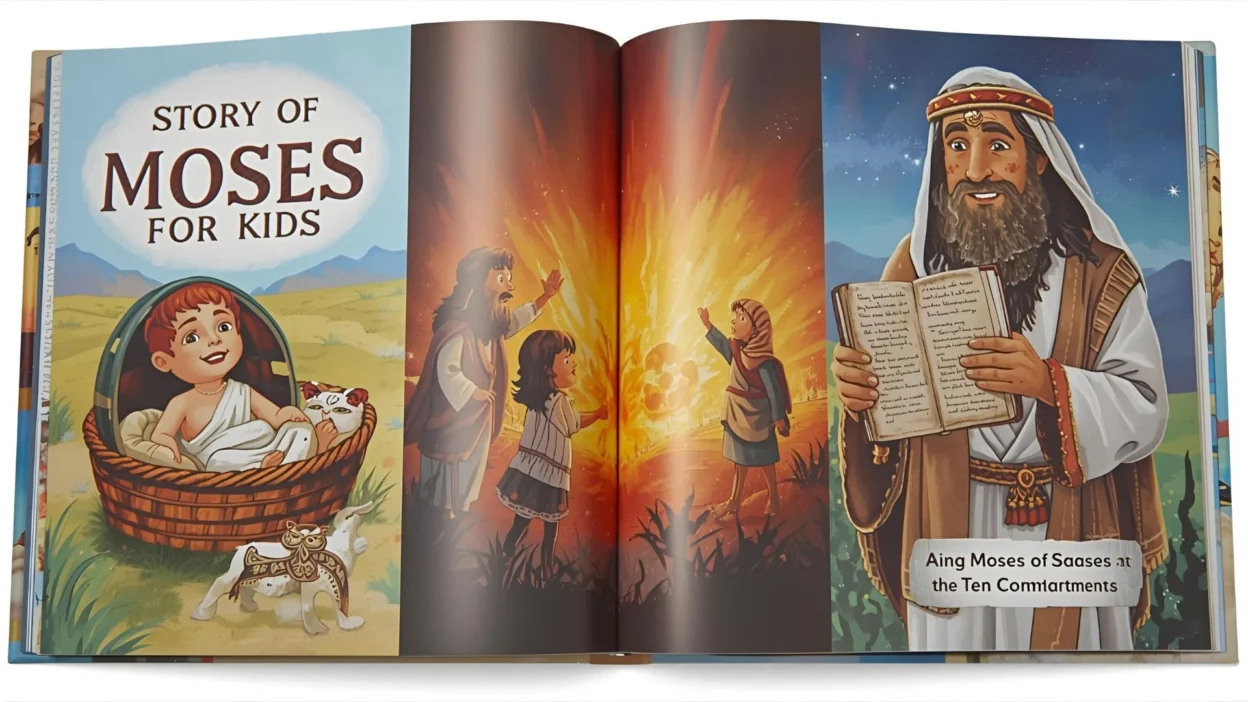
Long ago, in Egypt, a cruel Pharaoh feared the growing number of Israelites and ordered all Hebrew baby boys to be killed. In this dark time, a Hebrew woman named Jochebed gave birth to a son. She loved him dearly but knew keeping him hidden would be dangerous.
For three months, she kept her baby safe. But as he grew, it became harder to hide him from Egyptian soldiers. Trusting God’s plan, Jochebed placed her baby in a woven basket, sealed with tar, and gently set it afloat on the Nile River. His sister, Miriam, watched from a distance, her heart pounding with worry.
The basket drifted toward the palace, where Pharaoh’s daughter spotted it. Curious, she ordered her maid to bring it to her. Inside, she found a crying baby. Her heart melted. Though she knew he was a Hebrew child, compassion filled her, and she decided to raise him as her own.
Miriam bravely approached and offered, “Shall I find a Hebrew woman to nurse the baby for you?” Pharaoh’s daughter agreed. So Miriam brought Jochebed—the child’s own mother! Jochebed cared for her baby until he was old enough to live in the palace. There, Pharaoh’s daughter named him Moses, meaning “drawn out of the water.”
From the very beginning, God protected Moses, preparing him for a mighty mission ahead.
Moral: God always has a plan, even when situations seem hopeless.
Story 2: Moses and the Burning Bush
Years later, Moses grew up in Pharaoh’s palace but fled Egypt after defending an Israelite slave. He became a shepherd in Midian, living a quiet life far from the land of his birth.
One day, while tending sheep on Mount Horeb, Moses noticed a strange sight—a bush on fire, yet it was not burning up! He approached, puzzled. Suddenly, a voice called out from the flames, “Moses! Moses!” Terrified, Moses answered, “Here I am.”
It was God speaking. “Do not come closer. Take off your sandals, for the place where you are standing is holy ground.” Trembling, Moses obeyed.
God revealed His plan: “I have seen the suffering of My people in Egypt. I am sending you to Pharaoh to bring them out.”
Moses hesitated. “Who am I to do this? What if they don’t believe me? I am slow of speech.”
But God reassured him, saying, “I will be with you. Tell them ‘I AM’ has sent you.” God even gave Moses miraculous signs, like turning his staff into a snake.
Though fearful, Moses accepted the calling, knowing he was not alone—God’s presence would guide him.
Moral: When God calls you, He equips you with strength and courage beyond your own.
Story 3: The Ten Plagues of Egypt
Moses returned to Egypt with his brother Aaron as his helper. Together, they stood before Pharaoh and declared, “The Lord says: Let My people go!” But Pharaoh’s heart was hard. He refused, laughing at their demands.
So God sent a series of plagues upon Egypt. The Nile turned into blood, fish died, and the land stank. Frogs overran homes, gnats and flies filled the air, livestock perished, and painful boils broke out on people and animals.
Still, Pharaoh refused. Then came hailstorms, locusts that devoured crops, and deep darkness covering the land for three days. Each time Pharaoh begged Moses to pray for relief but hardened his heart again when the plague ended.
Finally, the last and most devastating plague arrived: the death of the firstborn in every Egyptian household. But God told the Israelites to mark their doors with lamb’s blood, so the angel of death would pass over them.
This broke Pharaoh’s pride. In fear and sorrow, he ordered the Israelites to leave Egypt at once. The journey of freedom had begun.
Moral: Pride leads to destruction, but obedience to God leads to deliverance.
Story 4: Crossing the Red Sea
The Israelites left Egypt joyfully, but soon Pharaoh regretted letting them go. He gathered his army, horses, and chariots to chase them. When the Israelites saw Pharaoh’s army approaching, they were terrified and cried out to Moses.
“Why did you bring us here to die in the desert?” they complained. Moses remained calm and said, “Do not be afraid. Stand firm and see the salvation of the Lord.”
God instructed Moses to raise his staff over the sea. Suddenly, the waters parted, forming towering walls on both sides. The Israelites walked through the sea on dry ground, amazed and trembling with awe.
Pharaoh’s army followed, but God caused confusion among them. Wheels fell from their chariots, and panic spread. As the last Israelite stepped onto safe ground, Moses stretched out his hand again. The waters crashed back, swallowing Pharaoh’s army completely.
The Israelites sang songs of victory, praising God for their miraculous escape. From slaves to free people, they saw God’s mighty hand delivering them.
Moral: With faith, even the impossible becomes possible when God fights for you.
Story 5: The Ten Commandments
After their escape, the Israelites traveled through the desert. At Mount Sinai, God called Moses to climb the mountain alone. There, surrounded by thunder, lightning, and smoke, Moses entered God’s presence.
For forty days and nights, Moses remained with God. The people below grew restless, but God was giving Moses something priceless—the Ten Commandments. Written on stone tablets by the very finger of God, these commandments were laws for His people.
They taught the Israelites how to honor God and how to live with one another. Commands like “You shall not steal,” “You shall not murder,” and “Honor your father and mother” became the foundation of their community.
Meanwhile, the people lost patience. They built a golden calf and began worshiping it. Angered, Moses descended with the tablets. When he saw their idolatry, he smashed them in sorrow. Later, after pleading with God for mercy, Moses returned to the mountain and received the commandments again.
The Ten Commandments were more than rules—they were God’s loving guidance for living a good life.
Moral: God’s laws guide us to live rightly and honor Him above all else.
Story 6: Water from the Rock
The desert journey tested the Israelites. They often grew thirsty, hungry, and discouraged. One day, they camped at a place with no water. Exhausted and frustrated, the people quarreled with Moses. “Why did you bring us out of Egypt just to die of thirst?” they shouted.
Moses, distressed, prayed to God for help. The Lord instructed him to take his staff and strike a specific rock at Mount Horeb. Though it seemed impossible, Moses obeyed.
As he struck the rock, water gushed out, flowing abundantly for everyone to drink—men, women, children, and even their animals. The people drank eagerly, their anger melting into relief.
This miracle showed God’s faithful provision even in harsh deserts. Yet, it also revealed the people’s weak faith. Despite seeing God’s wonders repeatedly, they often doubted and complained. Still, God continued to care for them with patience and love.
Moses named the place Massah and Meribah, meaning “testing” and “quarreling,” because the Israelites tested God, asking, “Is the Lord among us or not?”
Moral: God provides for our needs, even when circumstances seem impossible.
Story 7: Manna from Heaven
As the Israelites continued through the wilderness, food became scarce. Hungry and tired, they grumbled against Moses and Aaron. “In Egypt, we had plenty to eat! Why did you bring us here to starve?” they complained.
God heard their cries and promised to provide. The next morning, the ground was covered with a mysterious white, flaky substance. The Israelites looked at it and asked, “What is it?” Moses explained, “It is the bread the Lord has given you to eat.” They called it manna, meaning “What is it?”
Each family gathered just enough for the day, but some disobeyed and kept extra. By morning, it spoiled and was full of worms. On the sixth day, however, God commanded them to gather twice as much so they could rest on the Sabbath. Miraculously, the manna did not spoil that day.
For forty years, until they reached the Promised Land, God fed His people with manna. Each bite reminded them of His constant care and presence in their journey.
Moral: God faithfully provides for His people every single day.
Story 8: Moses Strikes the Rock Twice
Years passed, and again the Israelites found themselves without water. Frustration boiled over, and they shouted at Moses and Aaron. Moses prayed, and God commanded him to speak to the rock, and it would pour out water.
But anger clouded Moses’ heart. Standing before the people, he cried, “Must we bring you water out of this rock?” Then, instead of speaking, he struck the rock twice with his staff. Water gushed out, and the people drank.
Though God still provided, He was displeased with Moses’ disobedience. God told Moses and Aaron that because they had not honored Him before the people, they would not lead Israel into the Promised Land.
This was a heavy consequence for Moses. Though a faithful leader, even he faced discipline when he disobeyed. It was a reminder that leaders must trust God fully, even when frustrated.
Moral: Obedience matters; even leaders must honor God’s instructions.
Story 9: The Bronze Serpent
As the Israelites journeyed, they grew impatient again. They complained against God and Moses: “Why did you bring us out of Egypt to die in the desert? There is no bread, no water, and we hate this manna!”
In judgment, God sent venomous snakes among them. Many were bitten, and some died. The people rushed to Moses in repentance, pleading, “We have sinned. Pray for us!”
God told Moses to make a bronze serpent and set it on a pole. Anyone who was bitten could look at the bronze serpent and live. Moses obeyed, and those who looked in faith were healed.
This strange miracle became a powerful symbol. It showed that salvation comes not through human effort but by trusting God’s provision.
Moral: Faith in God’s way brings healing and life.
Story 10: Moses Sees the Promised Land
After many years of leading the Israelites, Moses grew old. He longed to enter the Promised Land, but God had already told him he would not. Still, God allowed Moses to see it from afar.
God led him to Mount Nebo. From the peak, Moses gazed upon the lush valleys and hills of Canaan—the land flowing with milk and honey, promised to Abraham’s descendants. His heart swelled with both joy and peace.
Though he could not step into it, Moses knew his mission was complete. He had delivered God’s people from slavery, guided them through the wilderness, and prepared them for their future.
On the mountain, Moses died peacefully, and God Himself buried him in a hidden place. The Israelites mourned their leader deeply, remembering him as the man who spoke with God face to face.
Moral: True greatness is fulfilling God’s purpose faithfully, even if we don’t see the full reward.
📌 Conclusion
The story of Moses for kids remains one of the best, hot, and trending 2025 biblical lessons, filled with courage, obedience, and faith. Whether you explore the life of Moses for kids, engage in story of Moses for kids activities, or read the story of Moses for kids summary, each tale holds wisdom for adults teaching children. From the story of Moses in the Bible summary to the full story of Moses, his journey shows that God provides, leads, and fulfills His promise.