
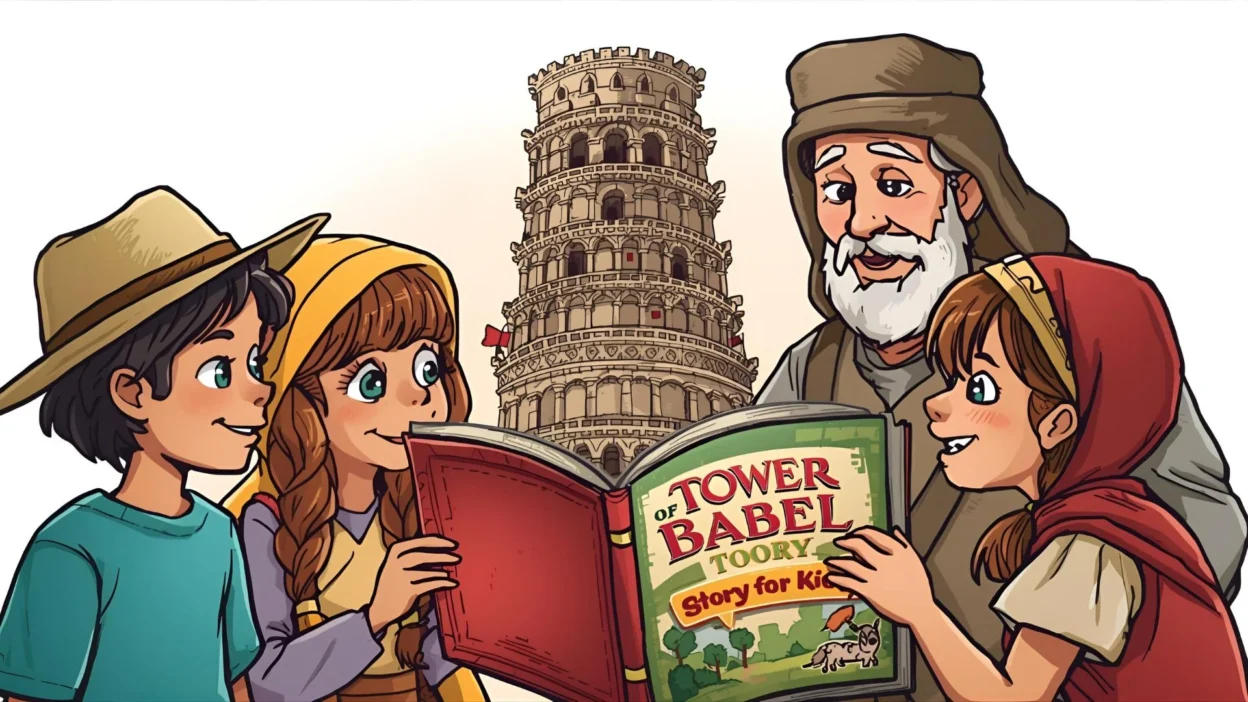
The Tower of Babel story for kids is one of the most hot and trending biblical tales that parents and teachers are looking for in 2025. With its timeless lessons of unity, pride, and humility, this story continues to inspire children and adults alike. Whether you’re searching for the Tower of Babel story summary for kids, a Tower of Babel short story for kids, or even a Tower of Babel story for toddlers, you’ll find it here in engaging formats.
We’ve also included storytelling ideas that can work as Tower of Babel story activities and even moral lessons that resonate with youth. These are the best stories retold in simple, powerful ways—perfect for parents, educators, or anyone seeking meaningful life lessons.
Story 1: The People Who Wanted to Reach the Sky
Long ago, after the great flood, people spoke one language and lived together in harmony. They traveled to the land of Shinar and decided to build a city with a massive tower that reached the sky. Their goal was to make their name great so they would never be scattered across the earth.
The people worked with determination. They made bricks, built walls, and laid foundations. Every hand contributed, and the tower grew taller each day. Pride filled their hearts, and soon they believed there was nothing they could not achieve.
But God looked down and saw what they were doing. He understood their intentions were not pure. They were building for their glory, not His. If they succeeded, they would forget their Creator and depend only on themselves.
So, God confused their language. Suddenly, workers couldn’t understand one another. A man asked for bricks and was handed water. Another called for tools and received straw. Confusion filled the city, and arguments broke out everywhere. The construction slowed and finally stopped.
Unable to continue, the people scattered across the earth, just as God intended. The once tall and proud tower stood unfinished, a symbol of human pride and failure.
The story of the Tower of Babel became a lesson for generations—that pride leads to division, while humility brings people together.
Moral: Pride divides people, but humility unites them.
Story 2: The Children Who Tried to Rebuild the Tower
Years after the original Tower of Babel fell into ruin, children in the city gathered near its broken stones. They often played there, imagining how tall the tower once stood. One day, they decided to rebuild it.
With sticks, stones, and clay, the children worked together. At first, the game was joyful. They laughed, planned, and pretended they were mighty builders. Each one added a piece, and slowly their small “tower” began to grow.
But as the game continued, pride slipped in. One child declared, “I’m the best builder!” Another shouted, “No, I made it taller!” Soon, they argued and stopped cooperating. The tower collapsed under their fighting hands.
An old woman, watching nearby, approached them. She smiled and said, “Do you see what happened? When you worked together, your tower stood. But the moment pride entered, it fell apart.”
The children understood the message. From then on, they promised to play with cooperation, not competition. Their small tower became a symbol of friendship and teamwork.
Moral: Teamwork builds strength, but selfish pride destroys it.
Story 3: The Farmer Who Learned from the Tower
In a nearby village, a humble farmer had always heard stories about the Tower of Babel. Curious, he visited the ruins. Standing among the broken stones, he wondered why such a strong tower never survived.
That night, he dreamed of the tower standing tall again. In his dream, people shouted in many languages, unable to understand one another. Their arguments shook the tower until it collapsed. The farmer woke up with a deep realization: communication is the foundation of any success.
Inspired, he decided to apply this lesson in his own life. When neighbors quarreled, he reminded them of the story. “We must understand one another,” he said, “or we will fall apart like the tower.”
Soon, the farmer became known for solving disputes. He built bridges of peace in his village, unlike the broken tower. The ruins remained a warning, but the farmer’s wisdom turned it into a blessing for others.
Moral: Without understanding, even strong foundations will crumble.
Story 4: The Traveler Who Heard Many Tongues
A weary traveler once reached the ruins of the Tower of Babel. He sat among the broken stones and listened carefully. Merchants, villagers, and wanderers from different lands passed by, speaking languages he could not understand.
At first, the traveler grew frustrated. He wanted to trade goods but couldn’t. He wanted to ask for food but was met with confusion. Anger bubbled within him, but then he stopped.
He noticed that although their words were different, their actions told stories. A smile meant kindness. A nod meant agreement. A shared piece of bread spoke louder than words.
The traveler realized something powerful: even if tongues divide, love and kindness are a language all people understand. He continued his journey, richer with wisdom, carrying this lesson in his heart.
Moral: Love is a language everyone can understand.
Story 5: The Young King and the Fallen Tower
A young king once visited the site of the old Tower of Babel. He looked at the ruins and felt pity for the people who had built it. “They failed because their hearts were proud,” his teacher reminded him.
The king thought deeply. “Then what should a true leader build?” he asked.
His teacher replied, “A leader should build trust, not towers. Walls may fall, but trust endures.”
Inspired, the king ruled his people with fairness. He never sought to make his name greater than theirs. Instead, he listened, forgave, and protected. His kingdom grew strong—not with stone, but with love and respect.
When he grew old, the king told his children, “The Tower of Babel fell because pride made it hollow. Let your hearts be full, and your people will never scatter.”
Moral: True leadership builds trust, not monuments.
Story 6: The Artist Who Painted the Tower
In a quiet village, an artist wanted to capture the lesson of the Tower of Babel. Instead of painting the tower tall and proud, he painted it broken and unfinished. Around it, he drew people scattered in every direction, each speaking a different language.
Some villagers criticized him. “Why not paint the tower standing strong?” they asked.
The artist replied, “Because the story is not about building a tower—it’s about learning humility.”
Years later, his painting was shown in many lands. Children, youth, and even kings looked at it and remembered the danger of pride. The unfinished tower in his painting spoke louder than any story.
The artist never became rich, but his art carried a timeless truth across generations.
Moral: Humility speaks louder than prideful achievements.
Story 7: The Teacher’s Lesson at the Ruins
A wise teacher once took her students to the ruins of the Tower of Babel. The children asked, “Why did this tower fall?”
The teacher knelt by the broken stones and said, “The people wanted to make their name greater than God’s. They built with pride, not with love. That is why their voices were confused, and the tower never stood.”
She picked up a small stone and handed it to the children. “This stone will remind you that greatness comes from serving, not boasting.”
The students carried the lesson home, never forgetting that the ruins were not just history, but a living reminder of humility.
Moral: True greatness comes from service, not pride.
Story 8: The Brothers Who Quarrelled
Two brothers lived in a village near the Tower of Babel’s ruins. They inherited land from their father and promised to share it equally. At first, they worked side by side.
But pride crept in. The older brother wanted more land; the younger brother wanted more grain. Soon, they fought bitterly. Neither could agree, and their bond grew cold.
One night, their mother told them the story of the Tower of Babel. “Pride and division destroyed that tower. Will you destroy your family the same way?”
Her words softened their hearts. The brothers forgave one another, shared their land again, and rebuilt their bond stronger than ever.
Moral: Family unity is stronger than selfish pride.
Story 9: The Wise Builder
A builder dreamed of making the tallest house in his village. He worked day and night, cutting no corners. But pride whispered in his heart: “Make it taller than all others, so everyone knows your name.”
He remembered the Tower of Babel story. “If I build for pride, my house will fall,” he thought. Instead, he built a small but sturdy home where neighbors could gather.
Soon, his home became a place of warmth, laughter, and unity. While others built tall houses that crumbled in storms, his stood strong because it was built with love, not pride.
Moral: Build with love, not with pride, and your work will last.
Story 10: The Grandmother’s Bedtime Tale
Every night, a grandmother told her grandchildren the Tower of Babel story. She described the people working together, their pride, and how God scattered them.
The children often asked, “Grandma, why didn’t God let them finish?”
She replied gently, “Because sometimes failure teaches more than success. If they had finished, they would have forgotten God completely.”
The children nodded, holding her hands. For them, the Tower of Babel was not just an old tale—it was a lesson about remembering who gives true strength.
As they grew, they carried her bedtime wisdom into their lives, choosing humility over pride in every step.
Moral: Failure can teach more than success when guided by wisdom.
📌 Conclusion
The Tower of Babel story for kids remains one of the top, best, and most trending lessons in 2025, teaching humility, unity, and love. From Tower of Babel story summaries for kids to short stories for toddlers, these retellings bring the timeless tale to life in simple, engaging ways.
Whether through a Tower of Babel activity, a lesson for youth, or even the Tower of Babel story with pictures, the core message stays the same: pride divides, but humility unites. These stories remind both children and adults that the greatest towers are built with kindness, not pride.