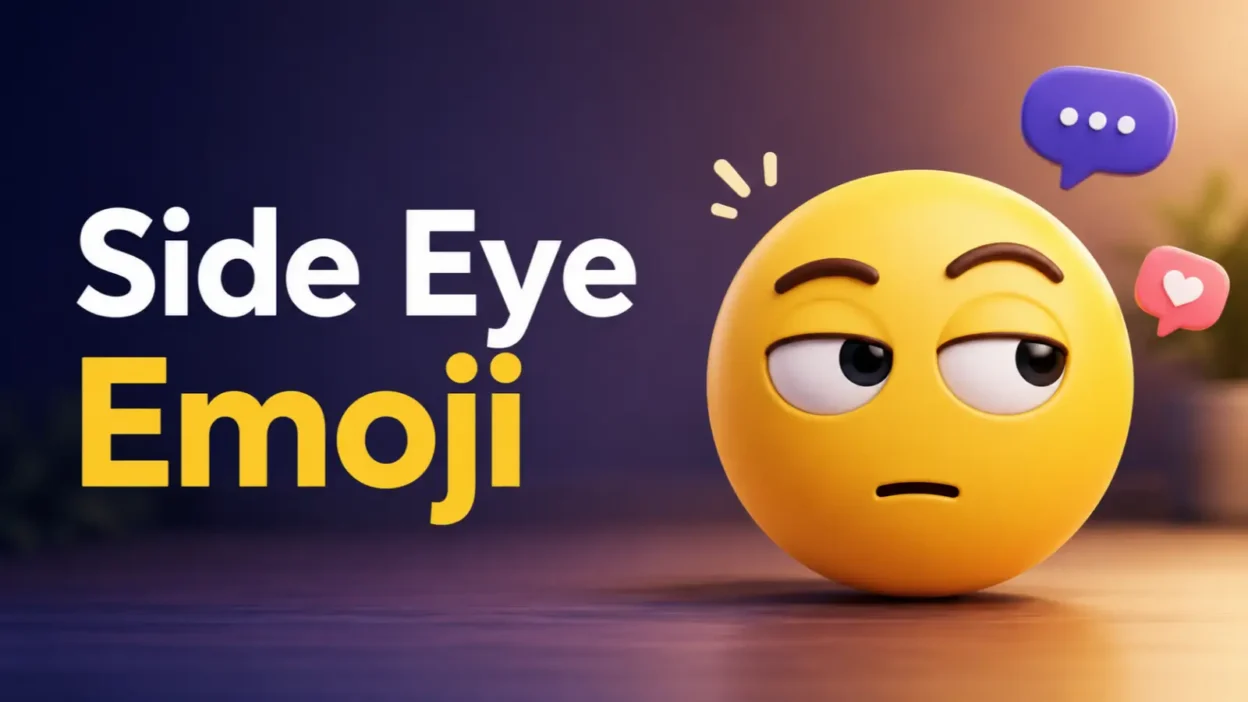
That sideways look can say “Really?” without saying a single word.
The side eye emoji 😒 is commonly used to show doubt, annoyance, disbelief, or an unimpressed reaction.
You may see it in a text, WhatsApp chat, Instagram comment, or TikTok reply when someone wants to give a quiet “Are you serious?” response.
If you are searching for the side eye emoji meaning, a copy and paste version, or the difference between 😒 and other reaction emojis, this guide explains how it is commonly used and why its meaning can change with context.
Sometimes one sideways look says everything.
What Does the Side Eye Emoji 😒 Mean?
The side eye emoji 😒 usually expresses skepticism, mild annoyance, displeasure, or an unimpressed feeling. It can be used when you do not fully believe what someone said or when their comment leaves you thinking, “Really?”
For example:
- “You forgot again? 😒”
- “You expect me to believe that? 😒”
- “He said he was only five minutes late 😒”
The same emoji can also be playful. A friend might send 😒 after a silly joke or exaggerated excuse without actually being angry.
Common meanings of 😒
Depending on the situation, 😒 can suggest:
- Doubt: “I’m not sure I believe you.”
- Annoyance: “That bothered me.”
- Disapproval: “I don’t like that.”
- Skepticism: “Are you serious?”
- Disbelief: “There’s no way.”
- Being unimpressed: “That’s not impressive.”
Context is important. A single 😒 from a close friend may be playful, while the same emoji from someone you do not know well could sound more critical.
😒 vs. 🙄
The 😒 emoji is often used for a side-eye reaction, but it is not exactly the same as 🙄.
😒 can feel like a quiet sideways look of doubt or annoyance.
🙄, the Face with Rolling Eyes, usually feels more openly frustrated, dismissive, or exasperated.
For example:
“You really said that? 😒”
sounds skeptical.
“Here we go again 🙄”
sounds more openly frustrated.
Side Eye Emoji Meanings at a Glance
| Emoji | Common meaning | Possible interpretation | Best used when |
|---|---|---|---|
| 😒 | Unamused, skeptical, annoyed | “Really?” | Mild irritation or doubt |
| 🙄 | Eye-rolling, frustration | “Seriously?” | Exasperation or sarcasm |
| 👀 | Watching, noticing, curiosity | “I saw that.” | Interest or attention |
| 🤨 | Questioning or suspicious | “Are you sure?” | Doubt or suspicion |
| 😏 | Smirking or knowing | “I know what you mean.” | Teasing or playful confidence |
| 🫤 | Uncertainty or discomfort | “I’m not sure about this.” | Mixed feelings |
These emojis can overlap, but they do not always create the same tone. The surrounding words usually help the reader understand what you mean.
Side Eye Emoji Cards
😒 Unamused Face
Meaning: Mild annoyance, skepticism, displeasure, or an unimpressed reaction.
Example 1: You really expect me to believe that? 😒
Example 2: That’s your excuse? 😒
🙄 Face with Rolling Eyes
Meaning: Frustration, sarcasm, disbelief, or exasperation.
Example 1: Not this again 🙄
Example 2: He forgot his keys again 🙄
👀 Eyes
Meaning: Paying attention, noticing something, curiosity, or interest.
Example 1: Wait, what happened next? 👀
Example 2: I’m watching this story closely 👀
🤨 Face with Raised Eyebrow
Meaning: Doubt, suspicion, questioning, or uncertainty.
Example 1: Are you sure about that? 🤨
Example 2: That’s an interesting explanation 🤨
😏 Smirking Face
Meaning: A knowing, teasing, confident, or slightly suggestive expression.
Example 1: I know you missed me 😏
Example 2: You thought I wouldn’t notice? 😏
🫤 Face with Diagonal Mouth
Meaning: Uncertainty, hesitation, discomfort, or mixed feelings.
Example 1: I’m not sure about that 🫤
Example 2: That sounds a little strange 🫤
How to Use the Side Eye Emoji in Texts and Social Media
The best way to use the side eye emoji is to match it with the tone of your message. It works especially well when you want to express a reaction without writing a long explanation.
On WhatsApp, 😒 can be a quick reaction to something annoying, questionable, or funny.
For example:
“You ate the last piece without asking 😒”
You can also send the emoji by itself:
“😒”
That short reply can communicate a lot when both people already understand the situation.
If you want a quick side eye emoji WhatsApp reaction, you can simply copy and paste 😒 into a chat, status, or reply.
On Instagram, the emoji can work in comments, captions, Stories, and direct messages.
For example:
“The confidence 😒”
or:
“You really posted that? 😒”
The surrounding words help show whether you are joking, teasing, or genuinely annoyed.
TikTok
TikTok comments often use reaction emojis to respond quickly to funny, awkward, or questionable moments. 😒 can add an unimpressed reaction, while 👀 can show that you are watching the situation closely.
Do and Don’t
Do:
- Match the emoji with your message.
- Think about your relationship with the reader.
- Add words when the meaning may be unclear.
- Use 😒 for mild reactions when you do not want to sound extremely angry.
Don’t:
- Assume everyone interprets 😒 in exactly the same way.
- Use it in a serious conversation if it may seem dismissive.
- Add many reaction emojis just to make a message more dramatic.
- Assume an emoji automatically makes criticism sound friendly.
Side Eye Emoji Copy and Paste — Best Combos
Looking for a side eye emoji copy and paste option? Here are some simple combinations for texts, WhatsApp, Instagram, and social media.
Funny & Sarcastic
😒😂 — A playful “I’m annoyed, but this is funny” reaction.
🙄😂 — A dramatic reaction to something ridiculous.
😒👀 — “I noticed that.”
Suspicious & Doubtful
😒🤨 — “Are you serious?”
👀😒 — “I’m watching, and I’m not impressed.”
🫤😒 — “I’m really unsure about this.”
Playful
😏👀 — A teasing or knowing reaction.
😒😏 — Playful attitude with a little skepticism.
🌚👀 — A humorous “I saw that” reaction.
Social Media Reactions
😒💀 — A funny reaction to something extremely ridiculous.
🙄✨ — Playful sarcasm about a dramatic situation.
👀😏 — Curiosity mixed with a teasing tone.
You can copy any of these combinations and use them in a message. Just remember that adding another emoji can change the overall feeling of the reaction.
Bombastic Side Eye Emoji
Bombastic side eye is a popular phrase used for an exaggerated or dramatic look of disbelief, judgment, or disapproval.
It is often used humorously online when someone says or does something ridiculous. The phrase became especially recognizable through social media and viral reaction content.
The 😒 emoji can represent an ordinary side-eye reaction, while bombastic side eye usually suggests a much more dramatic version.
For example:
“You really said that with confidence? 😒”
A creator might describe that reaction as a bombastic side eye when the look is intentionally exaggerated for humor.
Side Eye Emoji With Eyebrow
People sometimes search for the side eye emoji with eyebrow because a raised eyebrow can make a reaction look more suspicious or questioning.
There is no separate official Unicode emoji specifically called “side eye with eyebrow.” However, 🤨 Face with Raised Eyebrow can be useful when you want a stronger questioning or suspicious expression.
You can also combine it with 😒:
😒🤨 — A skeptical “I’m really not sure about that” reaction.
Side Eye Emoji Sticker and PNG
A side eye emoji sticker can be useful in WhatsApp chats, Instagram Stories, messaging apps, and social media reactions. Stickers are image-based, so their designs can be more exaggerated than standard Unicode emojis.
A side eye emoji PNG is also useful for memes, graphics, blog images, social media posts, or other visual content. Unlike a standard Unicode emoji, a PNG is an image file, so its appearance depends on the creator rather than the device’s emoji font.
Why Do Emojis Look Different on iPhone and Android?
The same emoji can look slightly different on an iPhone, Android phone, computer, or social media platform.
Apple, Google, Microsoft, Samsung, and other companies use their own artwork to display Unicode emojis. The underlying emoji can be the same even when the facial expression, eyes, shape, or other design details look different.
These small visual differences can sometimes affect how an emoji feels, but they do not automatically give it a completely different meaning.
Trending Side Eye Emojis in 2026
Side-eye-style reactions continue to fit modern online conversations because they let people communicate humor, doubt, and attitude quickly.
| Emoji | Current usage | Common context | Platform |
|---|---|---|---|
| 😒 | Unimpressed reaction | Texts, comments, replies | WhatsApp, Instagram, TikTok |
| 🙄 | Dramatic eye-roll reaction | Sarcasm and frustration | Texts and social media |
| 👀 | Watching or noticing | Curiosity and reactions | TikTok, Instagram, WhatsApp |
| 🤨 | Questioning reaction | Suspicion and disbelief | Texts and comments |
There is no single emoji that everyone uses in exactly the same way. Online communication keeps changing, and people often combine emojis with words, memes, stickers, and other visual reactions to create tone.
Cultural and Contextual Differences
Emoji interpretation can vary between people, cultures, age groups, online communities, and relationships.
For example, a close friend might use 😒 as a joke, while someone in a professional conversation might read it as disrespectful or annoyed. The safest way to understand an emoji is to look at the complete message and the situation around it.
Frequently Asked Questions
What does “👀” mean in text?
The 👀 emoji is called Eyes and commonly means “I’m watching,” “I noticed that,” or “Tell me more.” In texting and social media, it can also show curiosity, interest, or that someone is paying close attention to a situation.
What is this emoji 😒 called?
The 😒 emoji is officially called Unamused Face. It can express irritation, displeasure, skepticism, or an unimpressed reaction, which is why it is often used as a side eye emoji.
What does 🤦 mean in texting?
The 🤦 emoji is called Person Facepalming. It commonly expresses embarrassment, frustration, disbelief, or a reaction like “I can’t believe you did that.” Its exact tone depends on the conversation.
Was there ever a side-eye emoji?
There has not been a separate official Unicode emoji specifically named “Side Eye.” The 😒 Unamused Face is commonly used for a side-eye reaction, while 👀, 🤨, and 🙄 can also create similar feelings depending on context.
Can I copy and paste the side eye emoji?
Yes. You can copy and paste 😒 into texts, WhatsApp messages, Instagram comments, TikTok comments, and other platforms that support Unicode emojis. You can also copy combinations such as 😒👀 or 😒🤨 when they fit your message.
Is 😒 the same as the eye-roll emoji 🙄?
Not exactly. 😒 usually feels more like a sideways look of doubt, annoyance, or disapproval, while 🙄 more clearly suggests eye-rolling, frustration, or exasperation. They can overlap, but the tone is slightly different.
Conclusion
The side eye emoji 😒 is a simple way to show doubt, annoyance, disbelief, or an unimpressed reaction.
You can use it in texts, WhatsApp chats, Instagram comments, TikTok replies, and other social conversations.
Its meaning can change with context, so consider the words around it and your relationship with the person.
If you need a quick copy and paste emoji, a reaction, or a playful side-eye combination, 😒 can say a lot with very little.

I am Mehdi Hassan, a passionate content creator and the voice behind smallzstory.com, sharing engaging stories, captions, memes, and helpful content for readers worldwide.